Zeno’s Paradox of the Tortoise and Achilles

A paradox is  a statement that, despite sound reasoning from acceptable premises, leads to a conclusion that is contradictory.  For instance, “I always tell a lie” is a paradox because if it is true, it must be false.

Zeno of Elea (c. 450 BCE) is credited with creating several famous paradoxes, and perhaps the best known is the paradox of the Tortoise and Achilles which is embedded in the study of infinite series, and even more specifically, convergent series.

The set up is pretty simple: Achilles is racing a tortoise.  Achilles gives the tortoise a 100 yard head start, and while Achilles runs at 20 mph, the tortoise “runs” at 2 mph.  So, when does Achilles pass the tortoise?

Zeno used the following argument to prove that Achilles would never catch or pass the tortoise.  Figure 1, below, provides two snapshots once the race is underway.
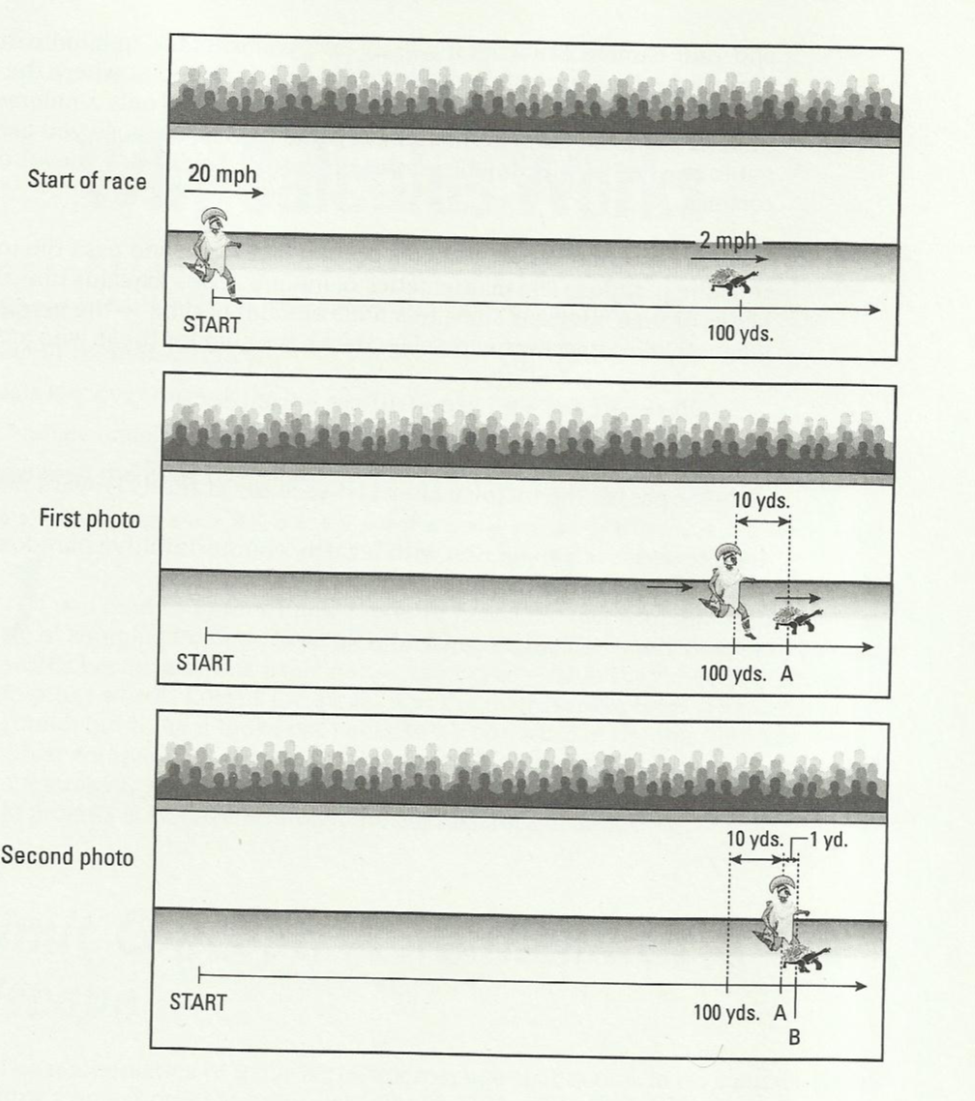
Paradox

The first snapshot is the instant Achilles reaches the point where the tortoise started.  By the time Achilles gets there, the tortoise has raced forward and is now 10 yards ahead of Achilles (remember, the tortoise moves a tenth as fast as Achilles, so in the time it takes Achilles to travel 100 yards, the tortoise covers a tenth as much ground, or 10 yards).

For the sake of Zeno’s argument, let’s pretend you have a really fast Polaroid and every time Achilles reaches the point where the tortoise was, you take another photo.  Using the picture above, the tortoise’s position is point A in the first photo.  Then you take your next photo when Achilles reaches point A, which takes him about one more second.  In that second, the tortoise has moved ahead to point B.  You take your third photo (not shown) when Achilles reaches point B and the tortoise has moved ahead to point C.  And so on…

Assuming you and your camera can work infinitely fast, there is no end to this series of photographs.  Thus, the argument goes: because you can never get to the end of your infinite series of photos, Achilles can never catch the tortoise.  The tortoise will always cover a tenth of the distance of Achilles.

Well, as everyone knows, Achilles does in fact surpass the tortoise.  Therein lies the paradox.

Posted in Science / Technology | Tagged , | Leave a comment

Part 1 Media Bias: Liberal or Conservative

A friend just emailed me the following video.  It’s yet another allegation that the media is liberal and that the conservative world view can’t get a fair shake.  Frankly, don’t watch it.  It’s a guaranteed waste of time but if you’re entirely unfamiliar with this assertion and need some context for this post, be my guest.

In the Political Economy of the Media, Robert W. McChesney makes a convincing case for why the conservative critique of the media being liberal is drivel.  According to McChesney, this claim rests on four propositions:

  1. The decisive power over the news lies with the journalists, and owners and advertisers are irrelevant or relatively powerless;
  2. Journalist are political liberals;
  3. Journalist use their power to advance liberal politics;
  4. Objective journalism would almost certainly present the world exactly as seen by contemporary US conservatives.

Basically, in order to claim that the media is liberal the first three conditions must be met.  In order for this claim to hold, and for one to maintain a commitment to professional journalism as it is presently understood, the fourth condition must also be met.  Let’s take a closer look at each proposition:

1.  The first point is intellectually indefensible and should be enough to call the entire conservative critique of the liberal news media into question.  As McChesney puts it, “no credible scholarly analysis of journalism posits that journalists have the decisive power to determine what is and is not news and how it should be covered.”  The fact is, in commercial media (like all things commercial), the owners hire and fire and they determine the budgets and the overarching aims of the enterprise.   As Robert Parry put it, “in reality, most journalist have about as much say over what is presented by newspapers and TV news programs as factory workers and foremen have over what a factory produces.”  Plus, if commercial media was so liberal, then why would conservatives be so obsessed with pushing public broadcasting to operate by commercial principles?  They know that the market will very effectively push the content to more politically convenient outcomes without any need for direct censorship

2.  The second proposition has the most evidence to support it.  Surveys show that journalist tend to vote Democratic in a greater proportion than the general population.  In one famous survey of how Washington correspondents voted in the 1992 presidential election, something like 90 percent voted for Bill Clinton.  To some conservatives, that settles the matter.  But, the first point undermines the importance of how journalists vote.  Again, what if owners and managers have the most power?  Surveys show that media owners and editorial executives vote overwhelmingly republican.  A 2000 Editor & Publisher survey found that newspaper publishers favored George W. Bush over Al Gore by a 3 to 1 margin.

3.  As for the third proposition, the evidence is far from convincing.  One of the core points of the professional code of journalism is to prevent journalist from pushing their own politics into the news, and many journalist, republicans and liberals alike, are proud to note that in spite of their political beliefs, their coverage tends to bend the stick the other way in order to prevent the charge that they are unprofessional.

4.  And finally, the proposition that truly objective journalism would invariably see the world exactly the way Rush Limbaugh and Sean Hannity see it, points to the ideological nature of the exercise.  Name an instance, or better yet, identify a pattern, where conservatives criticize journalist for being too soft on right-wing politicians or unfair to liberals on the left.  It’s a one way street.

As for the overarching theme of this post, is media bias liberal or conservative, I take the 5th for the time being.  McChesney’s logic makes sense to me and offers a fairly convincing argument against the contention that media bias is liberal.  But, that doesn’t necessarily mean media bias is conservative.  I will investigate that issue and get back to you all in, wait for it, Part 2 of Media Bias: Liberal or Conservative.

Posted in Culture, Media | Tagged , | Leave a comment

Difference Between Liberals and Conservatives

By most accounts, the polarization of Congress is at an all-time high.  If you’re a generation Y’er like me, you’ve witnessed an increase in lawmakers voting along party lines, making the debate over issues fervently one-dimensional.  The Atlantic Wire provides a chart illustrating how, from 1982 through 2011, the Senate (remember that Senators are supposed to be the reasonable ones) has “no remaining ideological overlap between the Democratic and Republican parties…as the vote ratings, for the first time, were divided neatly by party line.”  Albeit the chart ends in 2011, we are arguably witnessing the same intensity of partisanship surrounding the topics of the day: government spending and the debt ceiling.

As if the absence of overlap between party ideologies isn’t enough, voting against one’s own party ideology can be political suicide.  As of late, this cannibalistic temperament appears to be most prevalent in the Republican Party.  Just think of the infamous Grover Norquist pledge against raising taxes.  For over 20 years, this pledge hijacked the republican caucus’s ability to negotiate on tax rates and Norquist vowed to drive Republicans out of office if they refused to oppose tax increases.  Or simply, read Arlene Specter’s farewell speech to congress in 2010.  Specter, who spent three decades in the senate as a republican from Pennsylvania, complained that GOP senators had helped tea party challengers beat incumbent Republicans like Utah Sen. Bob Bennett and Rep. Mike Castle in his Delaware Senate primary.  Turns out colleagues didn’t appreciate their willingness to negotiate on health care reform and tax rates.  “Eating or defeating your own is a form of sophisticated cannibalism,” Specter said.

Given the anthropophagy taking place in today’s political arena, it behooves us to take a moment and map out some of the overarching differences between liberals and conservatives.  After all, we apparently have to pick sides.  Granted, subjectivity is inevitable (at least I’m willing to admit it) and “generalizations” / “stereotypes” have their limitations but, nonetheless, given the cacophony resounding from the chambers of congress and the channels of mass media, I hope you find the following exercise fruitful and thought provoking:

Source: Author

General Differences : “Liberals” and Conservatives

Liberal Conservative
Underlying Social Values more relativistic; more inclined to be sympathetic with cultural relativism and accommodation of minority cultures. more absolutist; more associated with belief in immutable or essential truths that are universal.
Individual relation to the State focuses more on the state’s responsibilities to create a level playing field politically and economically. focuses more on the state’s role facilitating individuals to purse “rational self-interests” in the economic and political arena.
Government more associated with advancing and expanding democratic forms: majority rule; universal suffrage, mass participation, popular sovereignty, etc. more focused on restraining the domain of government powers and on preserving the role of political, social and economic elites in government leadership.
Human Welfare more concerned with mobilizing State powers to protect vulnerable members: Welfare State. more committed to “survival of fittest”; wealth is a sign of something good being done;  poverty is a sign of failing behaviors:  Social Darwinism.
International Relations more commonly advocates for multilateralism  and role of international organizations. more commonly committed to unilateralism and patriotic nationalism.
  Economic more concerned with how the state regulates the economy and markets to protect social welfare; protecting individuals from the threat of overpowering economic groups. more concerned with the  “invisible hand” in economic process and supporting the “free market” unfettered by government interference.
 Religion focuses more on individual moral responsibility and toleration for religious minorities focuses more on the role of established religion and  religious leaders: clericalism:
 Crime focuses more on rehabilitation focuses more on punishment and retribution.
 Individual’s responsibility  more sympathetic to the need for people to help the  lesser accomplished and less able. more attracted to the idea that individuals should lookout for themselves.
 Primary Constituency more popular among intellectuals and the economically or socially vulnerable more popular among those who are  economically well-off and people of “fundamentalist” religious faith.
 References more focused on the results of scientific studies and “expert” or academic opinions. more inclined to reference historical documents and authors (e.g. Constitution, Declaration of Independence, Bible, Adam Smith, etc.)
 Philosophical Orientation  more oriented with what is practical and pragmatic more focused on what is consistent with “principles” and theoretical orientations.
Posted in Politics | Tagged , , | Leave a comment